Bruno Bearzi
1894–1983
Sculpture of a Horse
1955
In 1955, while visiting the Italian town of Legnano to pursue a business deal with the Officine Mario Pensotti boiler manufactory, Hacı Ömer Sabancı saw and admired a small horse sculpture in the Pensotti family home. Wishing to purchase it, he was instead presented with a gift: the factory owner’s son, Franco Pensotti, commissioned the Florentine foundryman Bruno Bearzi to cast a larger copy and presented it to Sabancı to celebrate their collaboration. The sculpture takes inspiration from the Horses of San Marco, which date back approximately two thousand years.
Widely known as the Horses of San Marco due to their placement on the façade of Saint Mark’s Basilica in Venice, the four gilt bronze horse statues were taken from the Hippodrome of Constantinople (today’s Sultanahmet Square) to Venice at the behest of Doge Enrico Dandolo during the Fourth Crusade in 1204. They are also referred to as the Venice Quadriga, after the Latin term ‘quadriga’ signifying a chariot drawn by four horses harnessed side by side. In the mid-thirteenth century, the group was placed in the loggia above the main entrance of the basilica dedicated to the patron saint of Venice, and subsequently pictured in the works of many artists including Gentile Bellini, Canaletto and Bernardo Bellotto. Following Napoleon Bonaparte’s annexation of Venice during the French Revolutionary Wars in 1797, the horses were taken as trophies to Paris. Placed on top of the Arc de Triomphe du Carrousel, they were restituted to Venice following Napoleon’s defeat in 1815. In the twentieth century, amid mounting concerns for the statues’ conservation, the horses were transferred to the San Marco Museum following a comprehensive restoration, and replicas were produced to replace them on the basilica’s façade.
The earliest known source pointing to the Venice Quadriga’s presence in Constantinople is the ‘Patria Sive Origines Urbis Constantinopolitanae’, dating from the tenth century CE. Listed among the multitude of sculptures and monuments adorning the Hippodrome, one of the most important sites of the Byzantine capital, are two different gilt bronze quadrigae which could ultimately be the Venetian horses. One group, comprising four horses, a chariot, and rider, were taken from the Milion Aureo Square, the starting point of Byzantine roads in Constantinople, and transported to the ‘neolea’ area of the Hippodrome, likely during the reign of Constantine I (r. 306–337). Another group, consisting of just four horses, were brought from Chios during the reign of Theodosius II (r. 408–450) and placed above the starting positions of the chariot races.
Although the questions of when, where and by whom the quadriga was made have been the subject of much research from the Renaissance to the present day, they have remained unanswered. Proposed dates for the statues’ creation range from the fourth century BCE to the fourth century CE; opinions differ over whether their origins are Ancient Greek or Ancient Roman. The quadriga is a motif found in both artistic traditions, usually in sculptures or coins celebrating a triumphant commander; it can therefore be assumed that the Horses of San Marco were also made to commemorate a victory. Although Lysippos (4th century BCE), one of the most renowned sculptors of the Classical Greek period, is put forward as a possible author of the group, the existence of numerous followers and imitators who produced works in the same style makes this claim mere speculation.
The horses’ manes are cropped in the Greek style, and their forelocks are tied upright. The ends of their tails are also bound. Their proportions do not fit any particular breed: their bodies are short and thick, their legs are long. These characteristics may in fact be precautions to counteract the perspective distortions which would occur when they were viewed from far below. It may therefore be assumed that they were designed specifically to be placed in a high position, perhaps on a triumphal arch or on columns. As a continuation of this tradition, the sculpture in the SSM collection is also placed on a high pedestal from which it greets museum visitors.
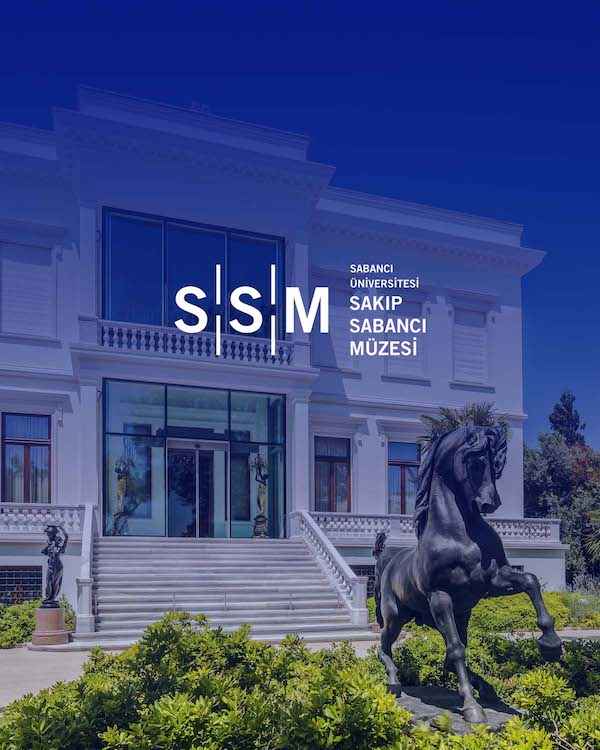
The bronze horse statue gifted to Hacı Ömer Sabancı, though not an exact copy of any of the San Marco Horses, clearly draws inspiration from them. Its left foreleg is raised, as if preparing to take a step, while its left hind leg is slightly bent in a continuation of this motion. The position of its legs and head matches that of the third horse from the left in the Venetian group. The horse is depicted with its mouth open, its head turned slightly to the left, with its left ear pricked forwards and right ear turned backwards.
The sculpture’s author, Bruno Bearzi, was known not only for his bronze casts but also for his conservation work. An expert in the metallurgical techniques and casting methods of Antiquity, Bearzi was tasked with protecting Florence’s statues during the Second World War, later restoring many works from Antiquity and the Renaissance. Among his most important restoration works are the gilt bronze relief doors made by Lorenzo Ghiberti for the Florentine Baptistery of San Giovanni, widely known as the ‘Gates of Paradise’; Donatello’s ‘Judith and Holofernes’ and Giambologna’s ‘Fountain of Neptune’. Bearzi directed the Vignali foundry and his export ledger for the 1950s includes not only the commission for Sabancı, but also many other bronze casts for clients all over the globe.
Detail
Dimensions:
yükseklik: 250 cm, genişlik: 290 cmMedium:
BronzeLocation:
Sabancı Üniversitesi Sakıp Sabancı Müzesi (Emirgan, İstanbul, Türkiye)Object Number:
400-0224Credit:
© Sabancı University Sakıp Sabancı MuseumRelated Works